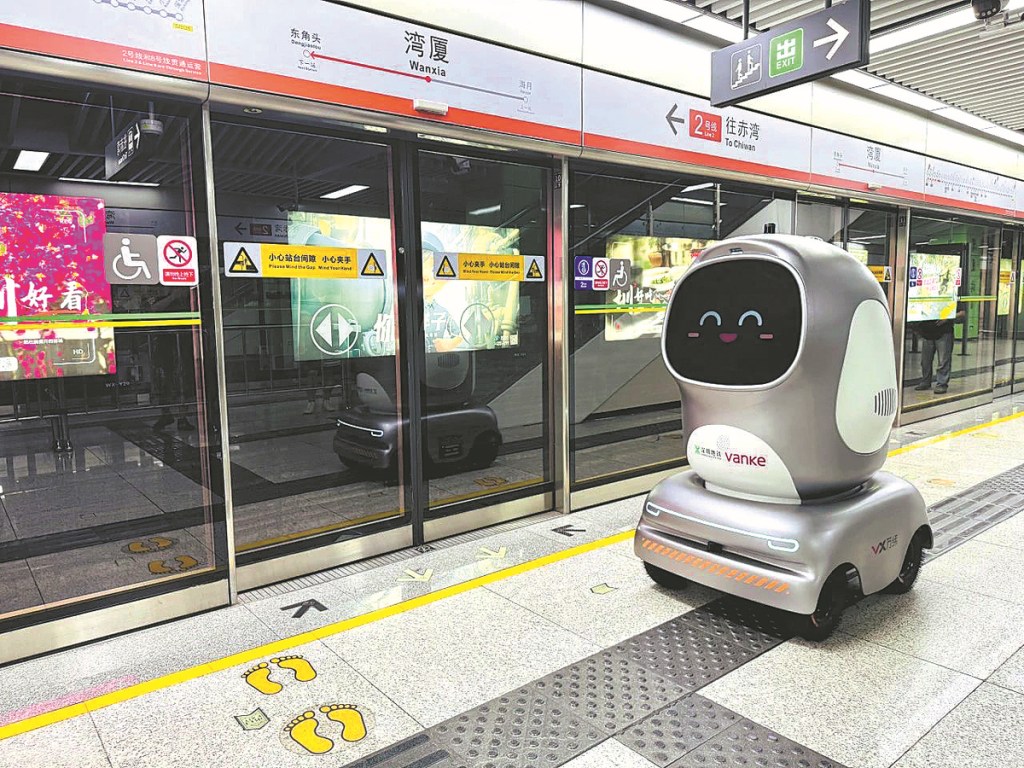
As Vice Dean of a university deeply invested in the intersection of technology, urban innovation, and user-centered design, I’m always drawn to real-world examples that illustrate the pace and promise of robotics in our everyday lives. This week, an extraordinary milestone was achieved in Shenzhen, China, where the world’s first autonomous delivery robot successfully completed an entire journey via the city’s Metro Line 2—without any human intervention.
This is not a speculative pilot or a lab experiment. It is a full deployment in one of the world’s most complex and densely populated transit systems. The project, jointly led by Shenzhen Metro Group and VX Logistics (a subsidiary of the Vanke Group), signals a dramatic shift in how cities can integrate robotics into public infrastructure—for novelty or automation, and for genuine logistical and sustainability gains.
A System Designed for Complexity
The robot—designed with a friendly, cartoon-like appearance—navigated metro stations, boarded trains, avoided crowds, and reached its destination to deliver goods to a 7-Eleven store. The sophistication required to accomplish this is nothing short of astounding!
The robot is equipped with real-time route optimization, multi-sensor navigation, and crowd-avoidance systems. These are more than machine-learning tricks; they are integrated technological systems that reflect a city-wide logistics strategy. The ability to interact with an active, real-world public space like a metro line requires a level of engineering that merges autonomy, safety, and efficiency.
This initiative is not a one-off event. A full fleet of 41 autonomous robots is scheduled to operate within Shenzhen’s metro network to handle peak-time delivery loads. These systems are designed to augment urban logistics during off-peak hours when roads are congested and surface delivery becomes inefficient and environmentally costly, humans will still be working with other delivery methods.
From Smart Cities to Autonomous Infrastructure
Shenzhen’s move fits within a broader ambition: its 2025–2027 smart infrastructure plan, which positions the city as a global leader in deploying “embodied intelligent robots.” While many cities are still piloting drone deliveries or warehouse robots, Shenzhen has taken robotics underground—integrating them seamlessly into the rhythms of public transportation.
This demonstrates a future where metro systems are part of a multi-layered logistics framework. In doing so, the city is redefining what “smart city” means—not just sensor-laden lampposts or 5G-enabled signage, but infrastructure that interacts, adapts, and serves multiple urban needs simultaneously.
Implications for Urban Design, AI, and Logistics
As an educator and researcher, I see enormous implications here for how we train the next generation of software engineers, urban technologists, and data scientists. Students studying robotics, AI, and urban systems should look closely at projects like this, which represent the convergence of autonomous mobility, real-time systems, human-machine interaction, and sustainable city planning.
Moreover, this moment offers a case study in the role of public-private collaboration in technological deployment. The partnership between Shenzhen Metro Group and VX Logistics shows how innovation can be accelerated when infrastructure owners and logistics providers align on goals, timelines, and civic impact.
The Speed of Change
What strikes me most is the pace at which this transformation is occurring. In just a few years, robots have moved from isolated, industrial contexts—factories, hospitals, warehouses—to the heart of public space. Autonomous systems are now safely navigating crowds, planning real-time delivery routes, and interacting with dynamic environments in cities like Shenzhen.
This marks a new era in robotics. We are seeing a shift from research and experimentation to real-world deployment and continuous improvement. What is being tested in Shenzhen today may soon be adopted in other major transit systems around the world.
Closing Thoughts
For educators, researchers, and policymakers, this initiative provides a compelling example of how robotics, when thoughtfully designed and strategically implemented, can contribute meaningfully to urban efficiency, sustainability, and citizen experience. It is also a reminder that the future of robotics is not abstract—it’s already underway, riding the metro.
As we shape our curricula and research agendas at IE University and beyond, we must consider how to prepare students not only to build these systems but also to think critically about their societal, ethical, and economic impacts. Shenzhen’s autonomous subway delivery robots are a symbol of what’s possible when innovation is paired with vision and execution.
 Robert Polding's Home
Leave a comment