Brussels, February 1, 2026
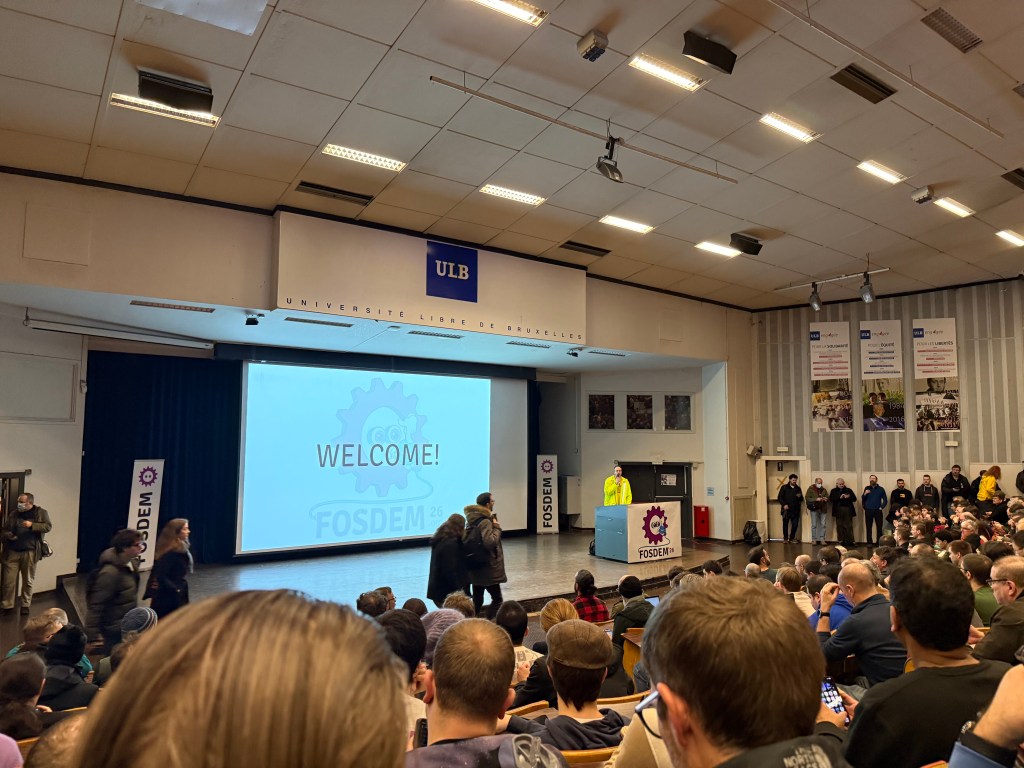
This weekend, I had the privilege of attending FOSDEM 2026 at the Université Libre de Bruxelles.
For those unfamiliar with FOSDEM, it is Europe’s largest gathering of free and open source software developers. What makes it remarkable is not just its scale – 1,195 speakers, 1,078 events, and 71 specialized tracks – but its ethos. Entirely volunteer-organized, non-commercial, and free to attend, FOSDEM embodies the very principles that should guide our approach to educational technology: community-driven, accessible, and focused on knowledge sharing rather than profit extraction.
As a vice dean, I’m acutely aware of the mounting pressures facing our institutions such as constrained budgets, rapid technological change, and the imperative to maintain our educational mission while adapting to new realities. Open source software offers a path forward that aligns with our academic values while providing practical advantages.
The conversations at FOSDEM this year centered on themes directly relevant to our work. Keynote discussions on “FOSS in times of war, scarcity and (adversarial) AI” and “Open Source Security in spite of AI” highlighted how open source communities are grappling with the same challenges we face – ensuring security, maintaining autonomy, and building resilient systems in uncertain times.
What struck me most was the emphasis on collaboration and capacity-building. Unlike proprietary solutions that create vendor lock-in and extract value from institutions, open source software allows us to develop internal expertise, customize solutions to our specific needs, and contribute improvements back to the broader community.
The session on “Reaching out to the wider society” particularly resonated with me. It explored how the open web movement can become a society-wide project, emphasizing digital democracy – concepts that align perfectly with higher education’s public mission.
Walking through the project stands, attending technical sessions, and engaging in hallway conversations with developers from around the world, I was reminded that we in higher education are not passive consumers of technology. We have the talent, the mission alignment, and increasingly, the necessity to engage more deeply with open source communities.
The specialized tracks on SBOMs and supply chain security, modern email infrastructure, and audio-visual creation tools demonstrated the maturity and sophistication of open source solutions across domains critical to our operations.
FOSDEM is more than a technical conference – it’s a demonstration of what’s possible when communities organize around shared values rather than commercial interests. As we navigate the challenges ahead, we would do well to embrace this model more fully in our institutions.
The question is not whether open source has a place in higher education, but whether higher education will step up to play its rightful role in the open source ecosystem – as users, contributors, and advocates for software that serves the public good.
I’m returning from Brussels energized and with concrete ideas for how we can strengthen our institution’s engagement with open source communities. The future of educational technology should be built on principles of openness, collaboration, and shared benefit. FOSDEM 2026 showed me that future is already being built – we just need to be part of it
 Robert Polding's Home
Leave a comment