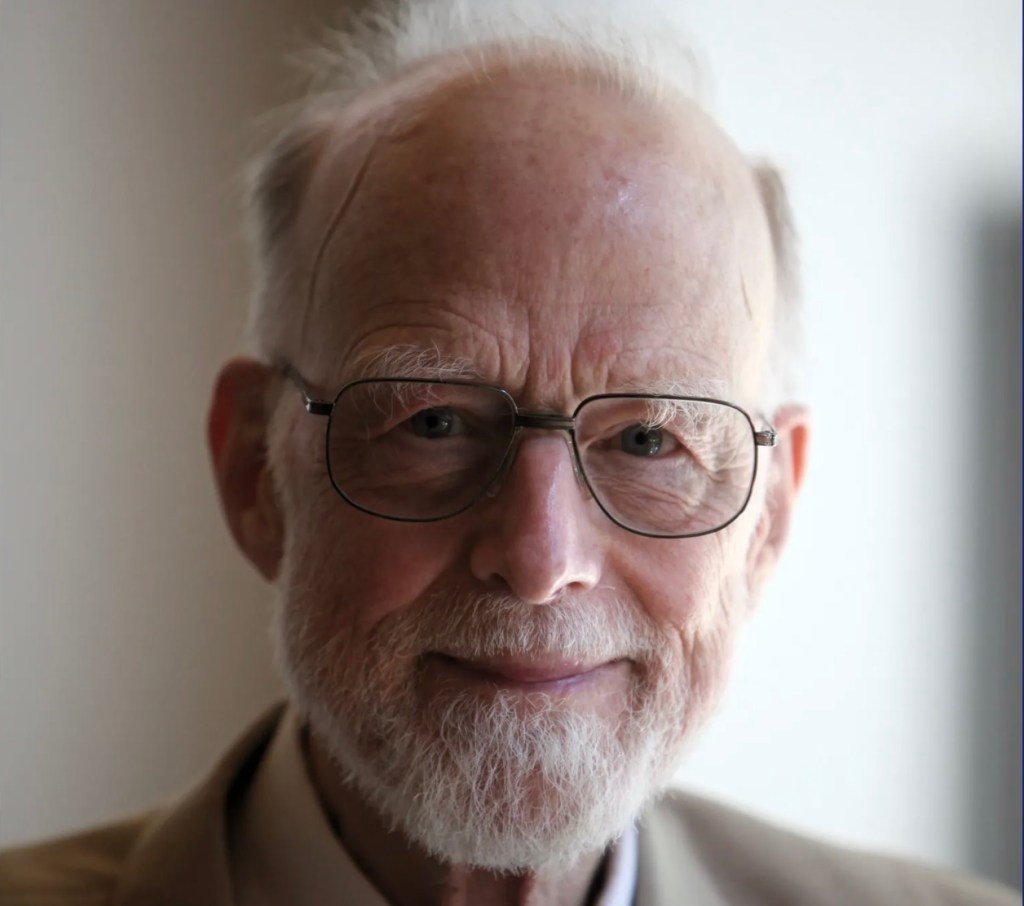
A Life That Shaped Computer Science
Earlier this month, the computing world lost one of its true giants. Sir Tony Hoare passed away on March 5th at the age of 92, leaving behind a body of work so vast that, as noted by the Communications of the ACM, had he accomplished just one of his many achievements, it would have been enough to constitute a prestigious scientific career.
I want to take a moment to reflect on what his life and work can teach us – not only about computer science, but about how to build a meaningful career.
An unconventional path into computing
One of the most striking details about Hoare is that he did not follow the path you might expect. He studied the classics at Oxford – not mathematics, not engineering – and he never earned a traditional doctorate. He began his career as a programmer and manager in industry before moving into academia. His background is a powerful reminder that there is no single “correct” route into our field. What matters is curiosity, rigour, and a willingness to think deeply.
Contributions that defined the discipline
It is difficult to overstate Hoare’s impact. Here are just a few highlights from his remarkable career, as documented by the ACM:
- Quicksort – Hoare invented this elegant sorting algorithm, which sorts an array of n elements in time proportional to in most cases. It remains one of the most widely used algorithms in the world and has been a staple of computer science education for decades.
- Axiomatic semantics (Hoare Logic) – He transformed earlier ideas into a full mathematical theory for proving properties of programs. Over the following 50 years, program-proving systems were built on the foundations he laid.
- Communicating Sequential Processes (CSP) – Hoare introduced the idea that communication, rather than low-level synchronization, should be the fundamental operation in concurrent programming. CSP became a full-fledged calculus with algebraic laws enabling formal proofs of complex computing processes.
- Programming methodology and data structuring – He contributed a foundational monograph on data structuring to the landmark book Structured Programming (1972), alongside Dijkstra and Dahl.
- Language design – He helped Niklaus Wirth design Algol W, introducing the concept of the record (known as a “structure” in C), bringing to data the same structuring principles that had transformed control flow.
The “billion-dollar mistake” – and what it teaches us
In a moment of characteristic honesty, Hoare famously described the null pointer – a feature included in Algol W – as his “billion-dollar mistake.” Whether or not the blame rests entirely with him (the concept dates back at least to McCarthy’s Lisp in 1959), his willingness to openly criticise his own design decisions is a lesson in intellectual integrity that every aspiring computing professional should take to heart.
Style, humility, and lifelong learning
What set him apart was his distinctive style – always elegant, always focused on what truly matters. In his own words, there was no clear boundary between research and writing.
Perhaps most inspiring for students is what those who knew him observed after his retirement from Oxford in 1999. He joined Microsoft Research Cambridge and, rather than resting on his laurels, threw himself into learning. He was known for sitting in the front row at conferences, carefully taking notes on even highly specialised topics. As the article’s author, Bertrand Meyer, puts it, Hoare embodied a rare combination of pride and humility – conscious of his accomplishments, yet always ready to go back to the school benches and start learning something new.
A leader who lifted others
Hoare had an extraordinary talent for helping the next generation come to terms with technology. He corresponded extensively with younger scientists, guided them through their careers, and attracted brilliant researchers to his Oxford Programming Research Group, which became a flowering ground for formal methods and concurrency research. His editorship of the Prentice-Hall Computer Science Series published dozens of influential titles that shaped the reading lists of generations of students.
What this means for you
Tony Hoare’s life offers several lessons worth carrying with you:
- Your background does not define your ceiling – a classics student became a Turing Award winner.
- Elegance matters – in your code, your writing, and your thinking.
- Never stop learning, no matter how much you have already achieved.
- Use your position to lift others up.
Stay connected to the community
The original tribute that inspired this article was published in Communications of the ACM, the flagship publication of the Association for Computing Machinery. The ACM is now fully Open Access, meaning anyone can explore its rich archive of research, biographies, and technical resources. For students looking to deepen their connection with the computing community, discover the work of pioneers like Hoare, and stay current with the ideas shaping our field, it is well worth exploring what the ACM has to offer – and considering becoming part of that community yourselves.
Sir Tony Hoare reminded us that great science is built on clarity, courage, and an unending desire to learn. Let us honour that example.
 Robert Polding's Home
Leave a comment