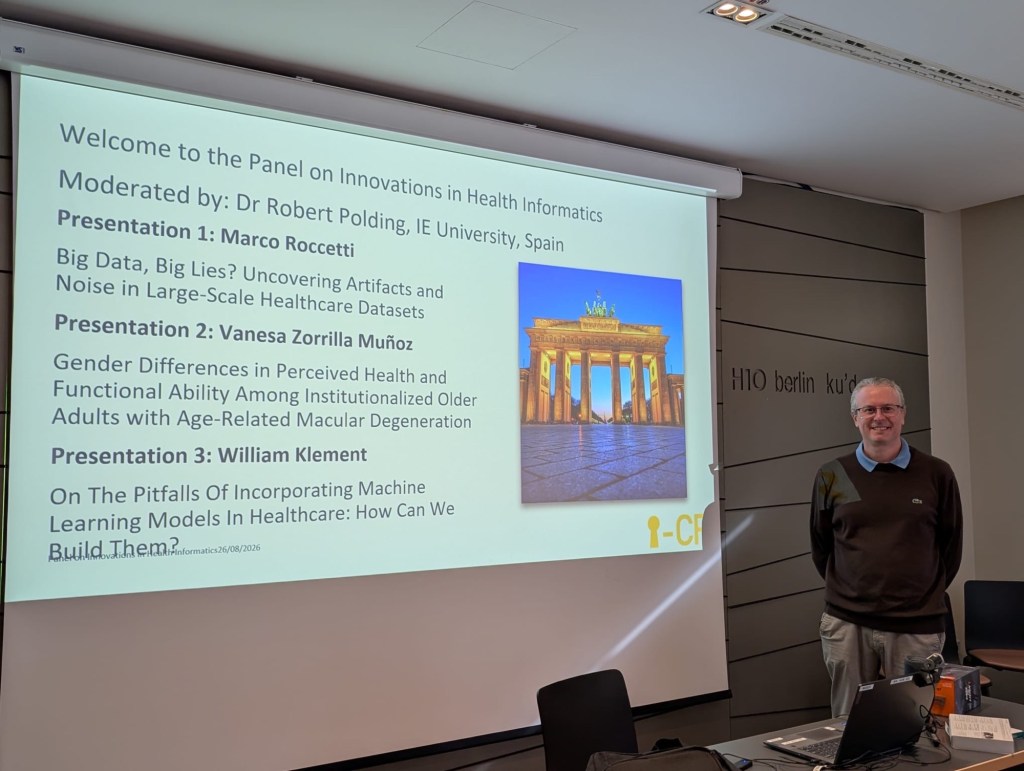
I recently had the opportunity to travel from Spain to attend The Fifth International Conference on Innovations in Computing Research (ICR’26). The event was held in Berlin, Germany, spanning from August 24 to 26, 2026. It was a fantastic week filled with rigorous academic discussions, topped off with some much-needed sightseeing.
Monday and Tuesday
My conference journey started strong on Monday, August 24, where I had the honor of kicking things off as a Session Chair. I chaired the very first session, which was dedicated to Data Science. Running in-person from 8:20 to 10:20 AM, the session set a great tone for the day. The presentations were outstanding, starting with Rebecca Papa, who discussed an AI-driven immersive VR biathlon designed for cognitive-motor enhancement in individuals with disabilities. We also heard from Ivan Gomes on data-driven water reuse assessment in textile processes, and Maryna Averkyna, who shared her work on mitigating fears related to change management in wartime. Marcus Grum rounded out the session with a fascinating look at deep learning for anomaly detection in industrial images.
I stayed to check out the research throughout Monday’s full schedule. The afternoon featured a robust Computer and Network Security session, Lauri Anttila’s research on fortifying water utilities against hybrid threats was excellent, and as was Geir Køien’s presentation on a quantum-safe identifier scheme for 6G systems. The day concluded powerfully with a keynote speech by Professor Stefan Wolfgang Pickl on the IRIS decision support framework.
On Tuesday, August 25, I was back at the venue, taking in all the fascinating morning sessions before the afternoon keynote scheduled for 3:20 PM. I attended the Health Informatics session, where Marco Roccetti quantified healthcare decision reliability, and Ghofrane Bousbih presented an automated malaria diagnosis system leveraging machine learning. Later, Kazem Taghva moderated an insightful panel on Innovations in Data Science alongside experts Marcus Grum, Chung-Chian Hsu, and Cecilia E. Nugraheni. The subsequent Data Science session was equally engaging, featuring Sobhan Ebrahimi Azar’s work revisiting Zipf’s Law in ICD-10 diagnosis codes and Chung-Chian Hsu’s deep learning model for traffic flow prediction. I stayed right up until Professor María Isabel González Vasco delivered her afternoon keynote on post-quantum cryptography.
Wednesday
Wednesday morning was the conclusion of my active participation. I arrived early to catch presentations in the Computer Science Education track, including Heidi Koivisto’s insights on AI-assisted code generation in software development and Mario Covarrubias’s talk on AI-enhanced VR shooting for inclusive student training.
From 9:20 to 10:20 AM, I had the privilege of acting as the moderator for a panel titled “Innovations in Health Informatics“. I was joined by an excellent group of panelists – William Klement, Marco Roccetti, and Vanessa Zorrilla-Muñoz – who made the discussion incredibly engaging.
Once my panel wrapped up at 10:20 AM, I decided to trade the conference halls for the vibrant streets of Berlin. I spent the rest of my Wednesday on a hop-on, hop-off bus. Taking in the city’s rich history, stunning architecture, and lively culture from the top deck was the perfect way to decompress. I absolutely loved Berlin and cannot wait to go back.


Leave a Reply