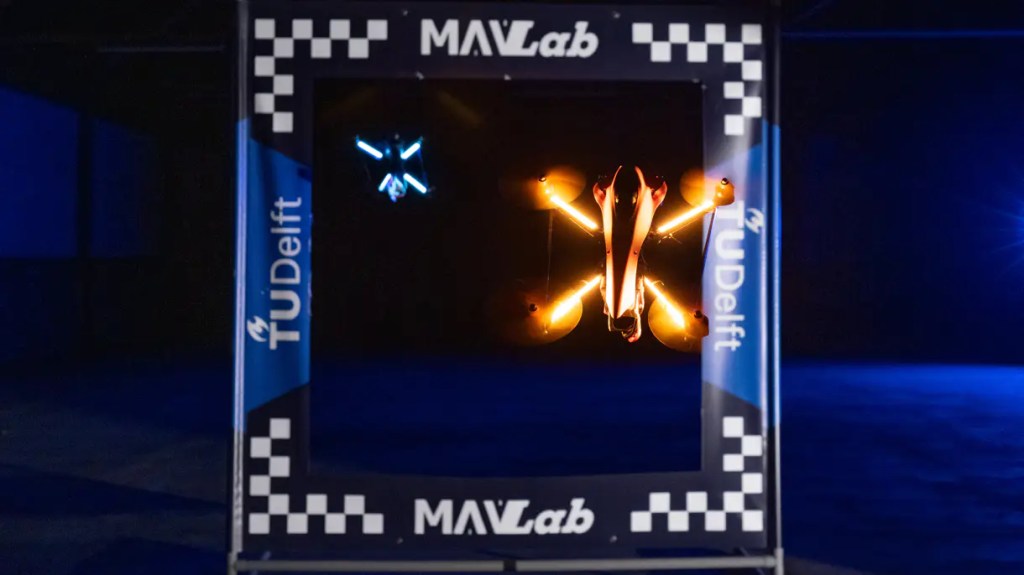
For years, drone racing has been the ultimate test of human reflexes. If you’ve ever watched first-person view (FPV) drone racing, you know it looks like something out of a sci-fi movie: pilots wearing headsets, reacting in fractions of a second to weave small, screaming machines through neon-lit obstacle courses at breakneck speeds.
It was a sport where humans, with our unparalleled intuition and spatial awareness, reigned supreme – until now.
In what many are calling an “AlphaGo moment” for aviation, an autonomous racing drone named MonoRace, developed by the Micro Air Vehicles Lab (MAVLab) at Delft University of Technology (TU Delft) in the Netherlands, has done the unthinkable. In a major international racing competition, it didn’t just participate; it outmaneuvered former human world champions to take first place.
How an End-to-End Neural Network Won the Race
Traditionally, autonomous drones have relied on a somewhat clunky “sense-plan-act” methodology. The drone’s computer would take in camera data, map its environment, calculate the optimal trajectory, and then send commands to the motors. In the high-stakes, high-speed world of drone racing, that tiny delay is the difference between crossing the finish line and crashing spectacularly into a wall.
The TU Delft team, led by researchers like Robin Ferede and Christophe De Wagter, flipped the script. They used an end-to-end neural network.
Instead of stopping to calculate flight paths, MonoRace’s AI learns to translate the visual data from its camera directly into motor commands. By cutting out the middleman (the traditional planning phase), the AI can make micro-adjustments on the fly. It pushes the drone to its physical limits, finding the absolute most efficient way through the air, a strategy that proved faster and more consistent than human intuition.
Why This Victory Matters Beyond the Track
It’s easy to look at this and think, “Great, another game we can’t beat computers at.” But the implications of MonoRace’s victory go far beyond the racing track.
Drone racing is essentially an extreme stress test. It forces developers to create AI that is not just incredibly fast, but also resilient and capable of making decisions with limited resources. The lightweight, highly efficient AI that allowed MonoRace to dominate the track is exactly what we need for practical robotics in the real world:
- Drones that can rapidly and safely navigate collapsed buildings or dense forests without a human pilot constantly at the stick.
- Delivery drones that can react instantly to unexpected obstacles, like a sudden gust of wind or a stray bird.
- The same highly-efficient neural networks could eventually power everything from smarter vacuum robots to safer self-driving cars.
The Future of the Skies
For human drone pilots, this might feel like a bittersweet moment. But for the rest of us, it’s a thrilling glimpse into a future where autonomous machines can operate safely and swiftly in the chaotic, unstructured real world.
The machines aren’t just learning to play our games anymore, they’re learning to master our physics.


Leave a Reply