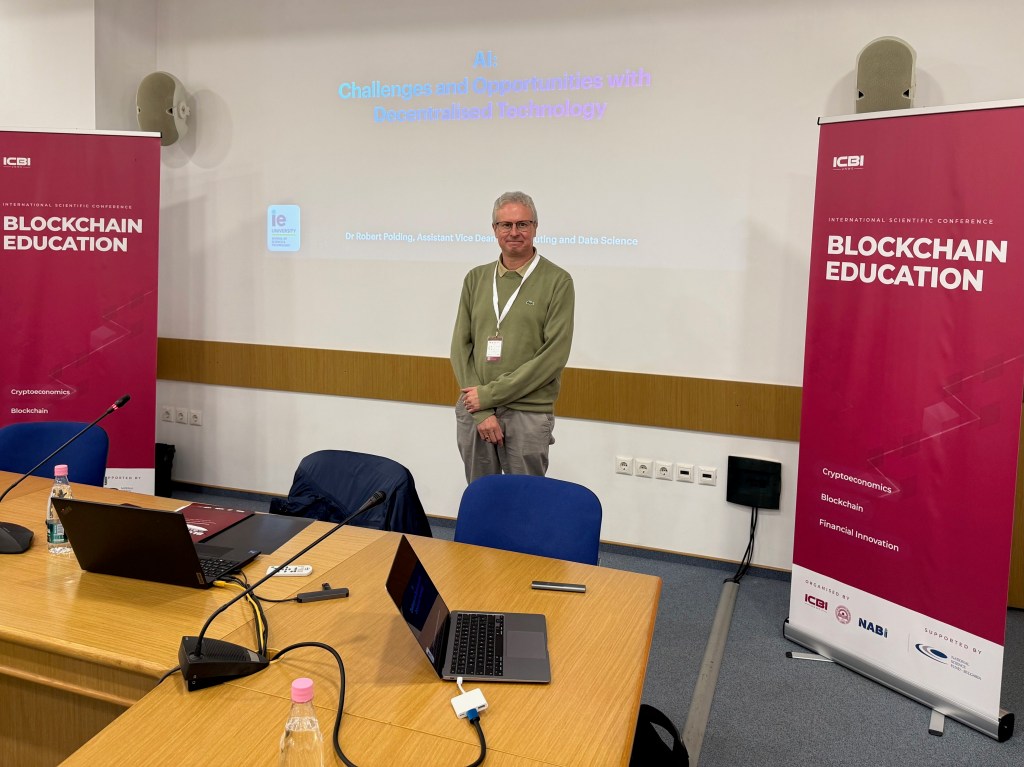
Attending the Blockchain Education 2026 conference in Sofia felt like a breath of fresh air. Hosted at the University of National and World Economy from October 29 to 31, the event gathered researchers and practitioners in cryptoeconomics and financial innovation for a weekend of debates and learning. For me, it was a rare chance to step away from solitary reading and explore a space where real people passionately debate the messy, practical realities of decentralized finance.
Unexpected News
The energy on that first morning was palpable. The three days were packed with 23 sessions, in both Bulgarian and English. I arrived early at the registration desk outside Aula Maxima. Holding a warm cup of coffee, I found myself chatting with peers about our latest projects. It is these quiet, informal moments that often remind me why I love academic gatherings.
But the relaxed mood shifted abruptly. Just before the opening sessions of the second day, a ripple of murmurs went through the crowd. News had just dropped that hackers had compromised a system linked to Binance, orchestrating a staggering 63 million dollar theft. The attackers had apparently used a highly sophisticated social engineering tactic, tricking an employee through a fake job interview to breach their computer.
This revelation made the conference interesting to say the least! Suddenly, our theoretical discussions felt incredibly urgent. Sharing ideas right before diving into complex academic panels took on a new weight, serving as a stark reminder that human vulnerabilities are just as critical as the technology itself. It also saw AI being used to undermine the security of stable coins, they pulled an amazing trick in using the stable coins as collateral for an Ethereum loan. They did this so quickly that when the assets were frozen they were in the accounts of the loan company, not the criminals.
Schedule Highlights and Industry Debate
The official opening still managed to set a rigorous standard for the days ahead. Hearing the welcoming remarks from Dimitar Dimitrov and Vasil Golemanski grounded us, providing a solid institutional context for the collaborative work to follow. The schedule itself was wonderfully curated to balance big picture macroeconomic theory with granular technological workshops, but that morning news inevitably hijacked the overarching discourse.
There was a lot of intense debate in the hallways and panel sessions about the future of the industry. The Binance incident functioned as a live case study, proving that systemic vulnerabilities often lie in human psychology rather than cryptography. The scheduled sessions challenged us to think deeply about how blockchain infrastructure can integrate into traditional finance while actually surviving these insidious social engineering attacks.
Accessible Rigour
What I appreciated most about this event was the genuine effort to keep the material accessible without sacrificing academic rigor. It is one thing to study consensus mechanisms alone at a desk. It is an entirely different beast to debate their real world implications in a room full of inquisitive minds, all while grappling with a live industry crisis.
Leaving Sofia, I feel a renewed sense of purpose. The insights I gathered, coupled with the stark realities of our current digital landscape, have deeply shifted how I plan to approach the digital economy in my future research.


Leave a Reply